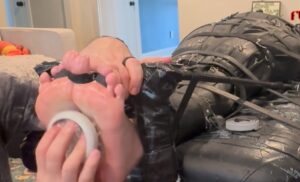
Baseline Evaluation Protocol: Immobilized Cutaneous Sensitivity Assessment via Tickle Table v1
Subject: Sweet Tease
FettishLabs Technical Documentation Series
Abstract
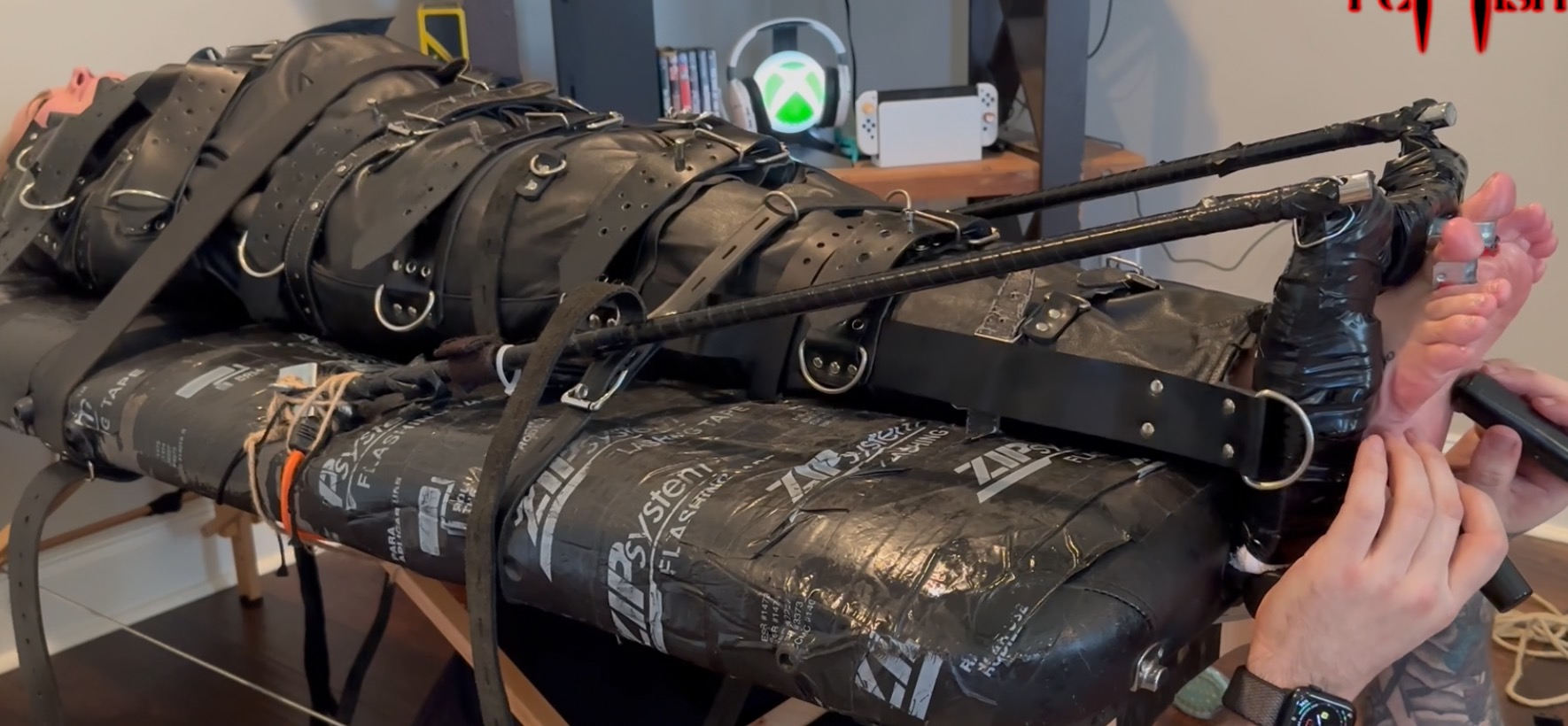
This paper documents the standardized baseline evaluation protocol conducted on FettishLabs Tickle Table v1, utilizing the Immobilizer full-body containment system with specialized ankle bracket toe-restraint apparatus. Subject Sweet Tease, a naive specimen with zero prior exposure to heavy bondage or intensive cutaneous stimulation, underwent comprehensive sensitivity mapping to establish physiological response baselines for subsequent research sessions. The v1 configuration’s unique toe-binding methodology (retrograde big-toe suspension via ratchet ankle bracket) demonstrated superior immobilization efficacy while presenting ergonomic limitations addressed in the v2 redesign. Results indicate high-amplitude response curves and complete immobilization success, validating the v1 architecture for maximum-restraint tickling research.
1. Introduction
FettishLabs maintains rigorous standards for specimen preparation prior to intensive sensory experimentation. The Tickle Table v1 represents the foundational architecture for our immobilized tickling research division, designed to render subjects helpless while exposing the primary target zones (plantar surfaces, interdigital spaces, and proximal phalanges) to unrestricted access.
The Immobilizer—a full-grain leather mummification enclosure with strategic cephalic and pedal apertures—with the ankle bracket assembly constitutes the core restraint matrix. Unlike subsequent iterations, the v1 features the proprietary Toe-Splay Suspension System: a mechanical bracket attaching to the ankle cuff with independent tethers for each digit, specifically configured to ratchet the big toes (halluces) into full rearward extension. This position hyper-extends the plantar tendons, eliminates protective curling reflexes, and presents the interdigital webbing for unimpeded access.
Subject Sweet Tease presents an ideal naive specimen profile. As a civilian bartender with no bondage experience, her responses lack conditioned tolerance, providing pure physiological data for our stimulation algorithms.
2. Apparatus and Materials
2.1 Tickle Table v1 Architecture
Surface: Reinforced steel core with 12-point belt slot matrix
Immobilizer: Full-body leather mummification sack, 0.8mm thickness, interior buckle system
Ankle Bracket Assembly (v1 Exclusive): Stainless steel cuff mount with dual ratchet mechanisms and micro-adjustable toe tethers
Restraint Matrix: 8 internal Immobilizer belts + 6 external table-mount straps
2.2 Assessment Methodology
Primary Researcher digits (fingers/nails)
Various sensory stimulation implements
Standardized pressure application protocols
Rhythmic consistency testing apparatus
3. Subject Profile
Designation: Sweet Tease
Age: 24
Occupation: Bartender (civilian extraction)
Experience Level: Null (zero prior bondage or tickling exposure)
Physical Attributes: Size 7 feet, high arches, sensitive cutaneous response history (self-reported)
Psychological Profile: Excessive bravado masking acute anxiety. Subject demonstrated anticipatory trembling upon visual exposure to the ankle bracket assembly, indicating heightened suggestibility and likely explosive response curves under stimulation.
4. Methodology
4.1 Containment Protocol
The subject was positioned supine on the Table. The Immobilizer sack was drawn upward from feet to neck, encasing the torso in leather compression. Internal belts cinched at ankles, knees, hips, waist, and chest, creating a vacuum-tight seal around the flesh.
Critical v1 Procedure: The exposed feet were inserted into the ankle bracket cuffs. The toe-tether lines were attached to each digit, with particular attention to the halluces. The ratchet mechanisms were engaged, drawing the big toes backward until the plantar surfaces achieved maximum tension and the interdigital spaces gaped open. This position prevents the protective “clawing” reflex common in tickling subjects.
Additional external straps secured the Immobilizer to the Table via the slot matrix: two across the shins, two across the thighs, one across the lower abdomen, and one sternal strap. Escape probability: 0%.
4.2 Baseline Evaluation Protocol
The Director conducted a systematic assessment progressing through defined phases:
Phase 1: Light Digit Exploration Bare fingertips traced the plantar arches, testing initial sensitivity thresholds. Subject exhibited immediate hyperventilation and vocalization.
Phase 2: Stimulus Calibration Sequential application across defined zones:
Zone A: Plantar heel
Zone B: Mid-arch
Zone C: Ball of foot
Zone D: Interdigital spaces (primary target given toe restraints)
Zone E: Distal phalanges (toe pads)
Each zone received varying pressure applications (feather-light to deep nail contact) and speed variations (slow circles to rapid fluttering).
Phase 3: Intensity Progression Combined stimulation deployment with psychological conditioning. The Director maintained verbal dominance, describing subsequent sessions while subject remained secured.
Phase 4: Sustained Application Continuous high-speed stimulation applied to the bound big toes, measuring endurance thresholds and vocalization decay rates.
5. Results and Observations
5.1 Physiological Responses
Heart Rate: Baseline 72 bpm ? Peak 168 bpm during Phase 4
Respiration: Rapid, erratic; subject experienced multiple hyperventilation events
Perspiration: Heavy diaphoresis within Immobilizer, particularly plantar surfaces (increasing conductive sensitivity)
Motor Response: Thrashing completely neutralized by restraint matrix; only head and vocal cords remained mobile
5.2 Vocalization Analysis
Subject progressed from controlled whimpering to elevated vocal output within Phase 2. By Phase 4, speech devolved into incoherent pleading and gasping laughter, indicating successful dissolution of psychological barriers.
5.3 Sensitivity Mapping
Highest Response Zones:
Zone D (Interdigital): Maximum reaction amplitude when stimulation penetrated between ratchet-bound toes
Zone C (Metatarsal heads): Secondary peak response to circular scratching
Zone E (Toe pads): Sustained high-frequency response, minimal habituation over time
5.4 v1 Apparatus Efficacy
The retrograde toe-binding proved exceptionally effective at preventing defensive curling. However, subject feedback (post-session) and Director observation noted circulation concerns during extended ratchet maintenance, informing the v2 redesign specifications.
6. Discussion
The Tickle Table v1 successfully establishes total physical domination over specimens. The Immobilizer’s leather compression combined with the external strap matrix eliminates all muscular leverage points, rendering the subject into a passive receptacle for stimulation.
The unique v1 toe-binding mechanism deserves particular emphasis. By mechanically drawing the halluces into extension, the subject loses the final defensive mechanism available to the feet—the ability to curl or clamp toes to protect the sensitive webbing. This exposure is critical for subsequent intensive sessions involving prolonged interdigital contact.
The subject’s novice status provided valuable data on unconditioned response curves. Unlike experienced fetish subjects who develop tolerance or performative resistance, Sweet Tease exhibited authentic, primal panic responses that rapidly transitioned into helpless hysteria. This validates our civilian acquisition protocols for maximum authenticity in stimulation research.