Endurance Testing in Controlled Sensory Environments: An Analysis of Self-Selected Temporal Commitment in Total Immobilization
FettishLabs Research Division – Protocol NS-2024-07
Principal Investigator: Derek [Redacted], Lab Director
Co-Investigator: Seneca [Redacted], Technical Consultant
Test Subject Designation: Emily Rose (Subject ER-09)
Classification: Restricted – Adult Research Archive
Abstract
This paper presents findings from FettishLabs’ endurance protocol examining psychological and physiological thresholds when subjects pre-commit to fixed durations of intense sensory application under conditions of absolute immobilization. Unlike standard research methodologies incorporating continuous withdrawal mechanisms, this study analyzes commitment depth when participants select their own exposure windows.
Subject ER-09, a 26-year-old female with limited prior intensive exposure, voluntarily selected a testing window of intermediate length. The subject was secured in a full-body containment system with anatomical exposure limited to cranial and plantar regions. Communication capabilities were restricted to emergency medical signaling only.
Results indicate significant psychological adjustment during intermediate phases, accompanied by parasympathetic responses. Post-experiment analysis reveals complex emotional processing regarding autonomy surrender under conditions of absolute temporal commitment.
1. Introduction & Background
Traditional experimentation at FettishLabs has historically incorporated dynamic consent models, allowing subjects to terminate application through established signals. However, emerging research suggests that the knowledge of escape capability fundamentally alters both physiological response patterns and psychological surrender depth.
The current protocol represents a paradigm shift toward absolute commitment frameworks. Subjects must pre-determine their testing duration before immobilization. Once secured within the apparatus, termination becomes medically impossible barring actual physiological crisis.
This methodology examines true psychological threshold analysis through the elimination of “option anxiety” – the cognitive dissonance created by perpetual choice availability.
Subject ER-09 presents a unique case study: a relatively untested specimen regarding intensive sensitivity, yet possessing significant containment experience through her relationship with Co-Investigator Seneca.
2. Methodology & Apparatus
2.1 Pre-Experimental Protocol
Subject ER-09 underwent standard intake processing including:
Cardiovascular screening
Panic disorder evaluation
Sensitivity mapping (preliminary testing indicated hyper-responsive nerve density)
Psychological readiness assessment
The subject was informed that emergency signaling represented solely a medical crisis device. Activation would trigger immediate termination and mandatory psychological monitoring, effectively disqualifying the data set.
2.2 Restraint Configuration
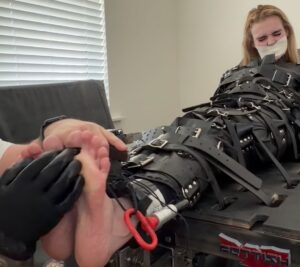
The subject was placed supine on the examination table. A heavy containment system was applied using the following sequence:
Lower extremity immobilization: Ankles secured with wide restraints attached to table fixtures; toes individually bound to prevent protective curling
Torso encapsulation: Heavy material drawn upward, arms pinned against flanks, secured at multiple points
Cranial exposure: Headstrap secured for psychological purposes. Mouth fitted with restriction preventing speech or verbalization
Final sealing: Upper material cinched at neck, creating complete immobilization from shoulders to hips
Escape probability: 0%
Communication capability: Limited to emergency binary signaling
2.3 Safety Mechanism
An emergency signaling device was placed in Subject ER-09’s hand prior to final securing. Testing confirmed effective activation. Usage parameters were strictly defined: medical emergency only.
3. Experimental Procedure
Phase 1: Initial Application
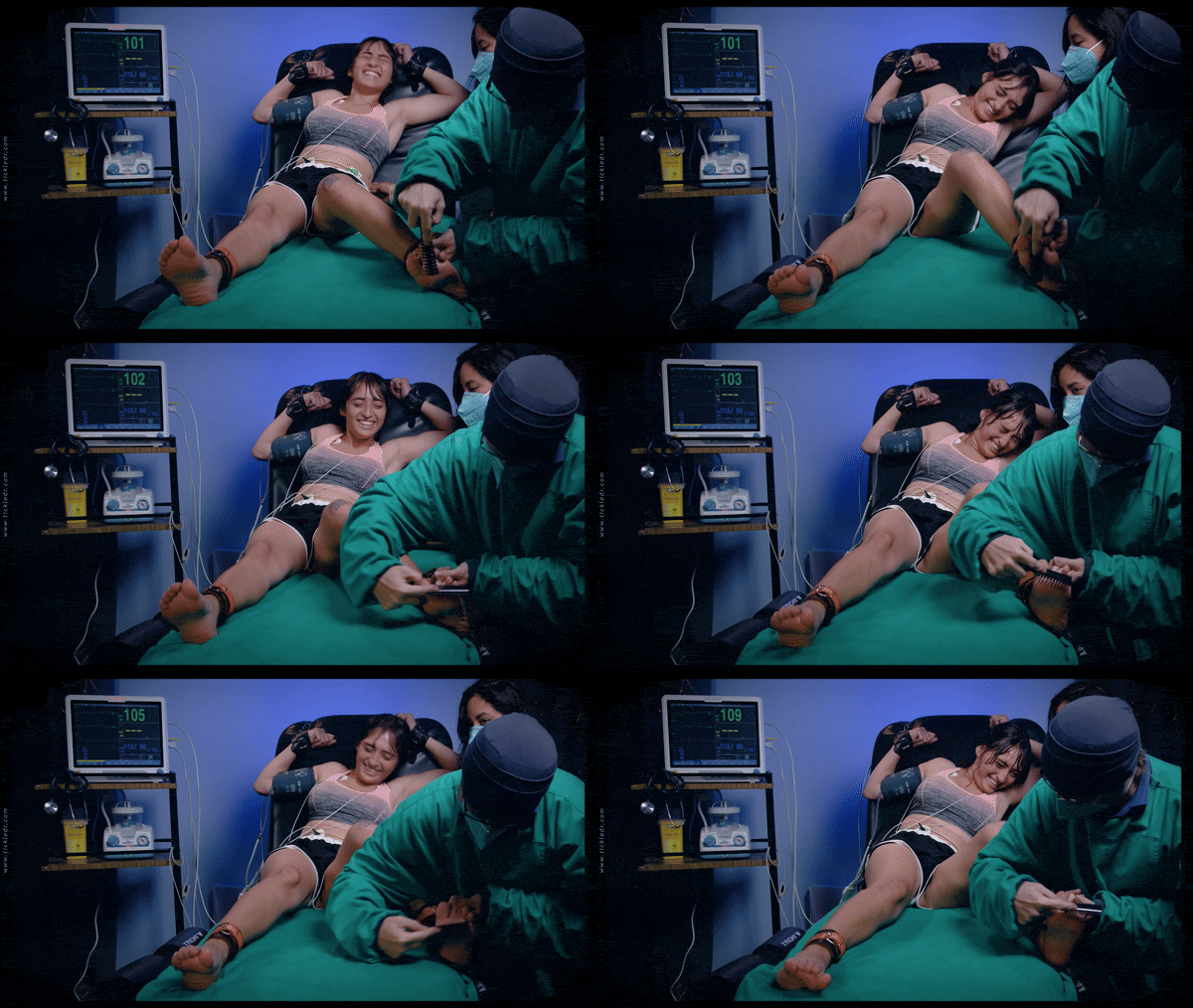
As Principal Investigator, I initiated the application sequence. With the subject completely encased and silenced, I began systematic plantar examination.
The bound toes – spread and immobilized via bindings – presented optimal access to the interdigital webbing and metatarsal pads. Using manual techniques, I mapped Subject ER-09’s immediate response patterns.
Initial observations indicated immediate struggling within constraints, muffled vocalizations, and lacrimation forming rapidly. Mid-sequence analysis showed subject transition from initial shock to compliance patterns, with emergency device held in ready position but not activated.
Critical threshold observed where subject entered dissociative state characterized by vacant stare, rhythmic head movement, and autonomic nervous system response. At this juncture, I ceased application to prevent premature medical termination, noting the subject had not utilized the emergency device despite clear physiological reactions.
Phase 2: Secondary Application
Co-Investigator Seneca – Subject ER-09’s partner and an experienced practitioner – assumed application duties. This represented a power dynamic inversion: the typically submissive partner administering stimulation under controlled laboratory conditions.
Seneca employed differing methodology utilizing soft implements and psychological commentary regarding subject’s helplessness, though responses were impossible.
Subject ER-09’s response to her own partner’s administration proved more psychologically complex than the Director’s examination. Post-interview analysis suggests the dynamic of being rendered helpless before one’s own partner amplified the psychological component significantly.
Final phases showed subject exhibited rhythmic, meditative physical response patterns, with emergency device remaining dormant but clutched. Plantar surfaces displayed sustained crimson flushing and nerve exhaustion. Termination occurred precisely at subject’s pre-selected temporal limit.
7. Conclusion
Subject ER-09 successfully completed her self-selected endurance trial, demonstrating that even sensory-naive specimens can achieve significant temporal thresholds under conditions of absolute immobilization and communication restriction. The data supports our hypothesis: when escape is rendered psychologically impossible through pre-commitment rather than merely physically restrained, subjects access endurance reserves inaccessible in traditional structures.
FettishLabs continues to refine these protocols. Future iterations will examine extended immobilization scenarios and the introduction of automated application devices to remove human mercy variables entirely.
Subject Status: Cleared for future testing
Recommended Next Trial: Extended session with automated implements
Risk Assessment: Elevated – Monitor for psychological adjustment 48 hours post-experiment
End of Report