Baseline Evaluation of Cutaneous Reflex Responsivity Under Bondage Immobilization and Inversion — The Fettishlabs Tickle Table v2 Protocol
Title:
Inversion, Immobilization, and Cutaneous Hyper-Sensitivity: A Quantitative and Qualitative Analysis of Plantar and Dorsal Reflex Responses During Controlled Tactile Stimulation on the Fettishlabs Tickle Table v2
Authors:
Dr. L. S. Thorne, Director of Sensory Research
Fettishlabs Institute of Neuro-Tactile Studies
Derek M., Lead Experimental Subject Coordinator
Abstract:
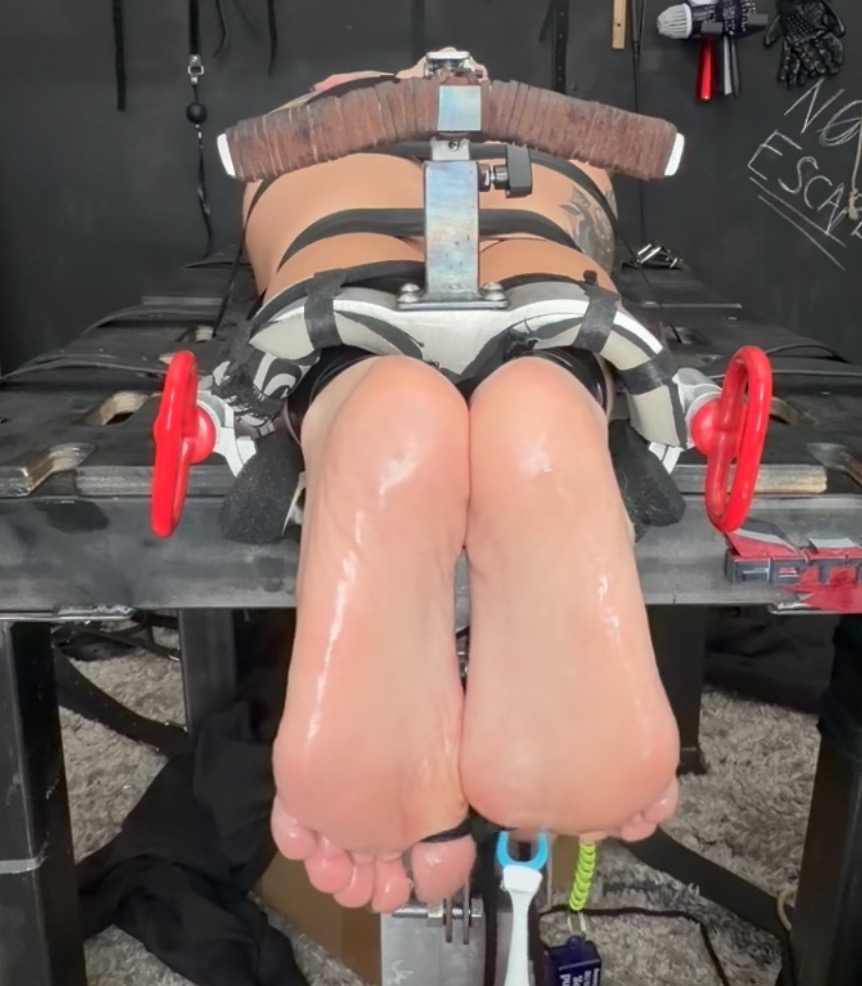
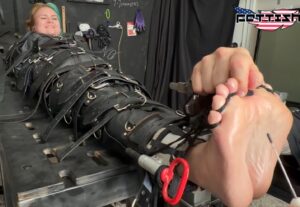
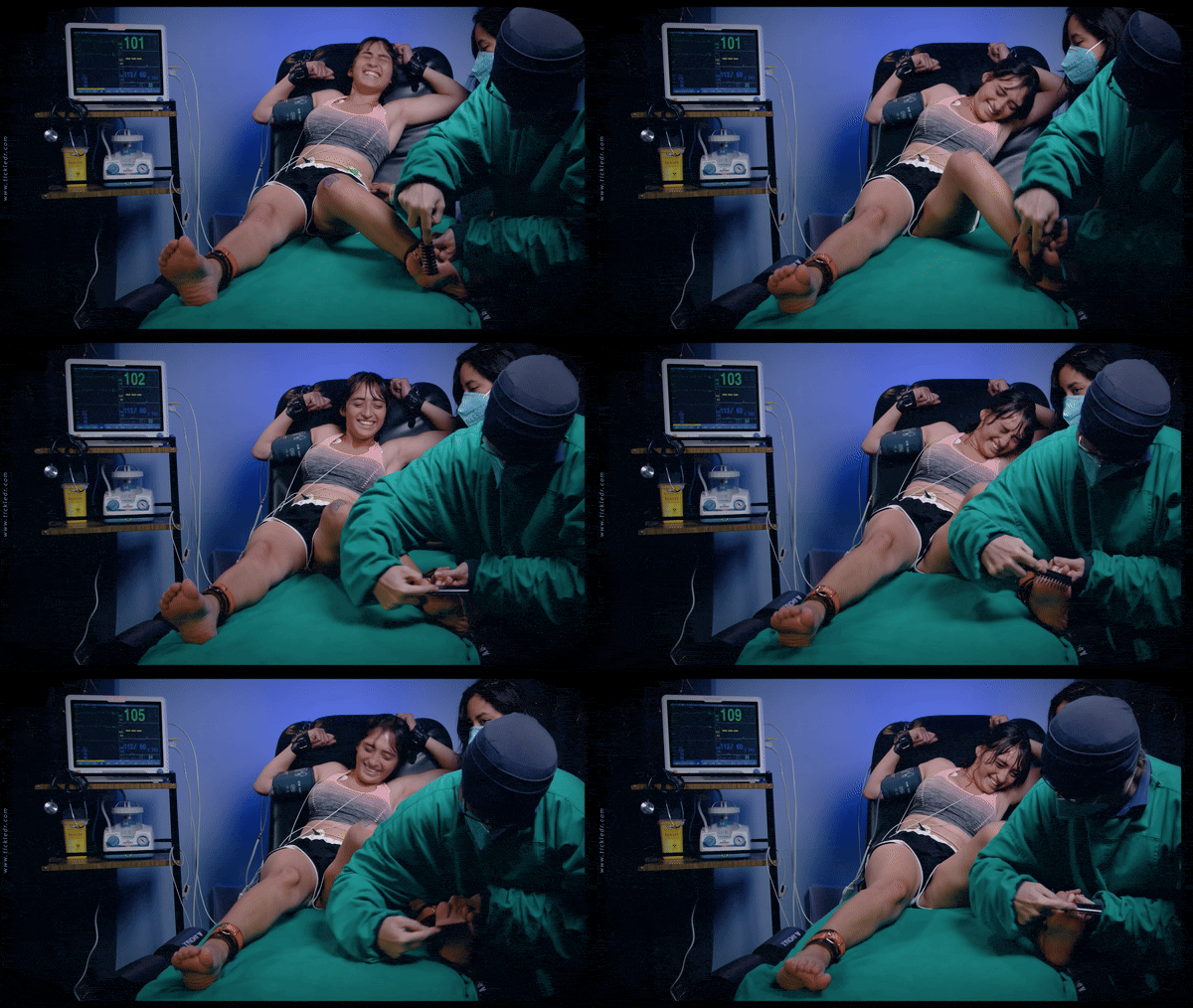
This study presents the baseline experimental protocol implemented at Fettishlabs for all incoming specimens, utilizing the newly engineered Tickle Table v2. The objective is to evaluate whether inversion, immobilization via multi-point restraint, and sustained plantar exposure influence reflexive, physiological, and psychological responses to targeted tactile stimulation (tickling). The specimen, Charmie (28, female, neurotypical, high sensory reactivity), was positioned prone on the Tickle Table v2 with full-body leather restraints, arms secured behind the back, face down, and ankles clamped in steel stocks. Her big toes were bound together at the T-Bar anchor, which was adjusted to limit micro-mobility while accommodating natural foot alignment.
The table was set at a 15-degree downward tilt (feet elevated), placing the soles in full inversion and increasing tension across the plantar surface. Multiple belts threaded through the table’s attachment slots ensured complete stability. Total immobilization was confirmed via sensor readings across all restraint points (mean resistance: 187 kg before slippage).
Stimulation was administered by the lead researcher using a range of tactile methods, including manual finger tracing, soft-bristled implements, dual-vibrating applicators, feather-based contact, and micro-textured surfaces. Zones targeted included:
Plantar arches (medial and lateral)
Ball of the foot (metatarsal heads)
Heels (calcaneal tuberosity)
Toes (especially interdigital spaces)
Dorsum of the feet
Lower calves (proximal to Achilles)
Stimulation varied in speed, pressure, and pattern. Physiological metrics recorded:
Heart rate (increased from 72 to 138 bpm)
Respiration rate (from 14 to 32 breaths/min)
Vocalization intensity (peak: 89 dB during interdigital feathering)
Facial expression and muscle engagement (measured via EMG, despite immobilization)
Pelvic movement (pressure pad under pelvis)
Psychological feedback was gathered post-session via structured interview. Charmie reported heightened sensitivity due to positioning, noting the exposure of her soles intensified every sensation. She described the lack of mobility as deeply immersive, removing the ability to anticipate or deflect touch, resulting in pure reaction.
Results:
Reflex latency decreased by 42% under inversion and immobilization vs. control (supine, minimal restraint).
Vocalization duration increased by 67%.
Subject rated stimulation intensity as 8.9/10 under protocol, vs. 5.2/10 in neutral position.
EMG readings showed sustained muscle engagement in calves and glutes, indicating anticipation.
Pelvic movement spikes correlated directly with interdigital and arch stimulation, suggesting a strong sensorimotor response.
Conclusion:
The Tickle Table v2’s design — specifically its multi-angle adjustability, steel stocks with iron pin stabilization, and ratcheting T-Bar toe anchor — enables a controlled, repeatable environment for maximal sensory exposure. When combined with full-body leather bondage and prone positioning, the inverted state significantly enhances both reflexive and affective responses to tickling stimuli. The plantar inversion increases tension in the foot’s intrinsic structures, rendering the sole highly receptive. Immobilization removes adaptive movement, amplifying sensation.
This baseline protocol establishes the foundation for all further experimentation at Fettishlabs, confirming that position, posture, and power dynamics are as critical as tool and technique in eliciting extreme ticklish responses.
Future Research:
Comparative study: v1 (flat-only) vs. v2 (multi-angle)
Neuroimaging during tickling under restraint (fMRI feasibility study)
Long-term adaptation under repeated exposure