Scientific Paper: Baseline Evaluation of Tactile Sensitivity and Reflex Response in the v2 Tickle Table Apparatus
Title: Neuromuscular and Affective Responses to Zone-Specific Tactile Stimulation Using the v2 Dynamic Tickle Table: A Controlled Baseline Study of High-Sensitivity Dermatomes in Restrained Subjects
Authors:
Dr. Derek, Lead Researcher & Director of Experimental Stimulation, Institute of Somatosensory Dynamics
Captured Kerry, Co-Experimenter & Sensory Calibration Specialist
Institution:
Department of Applied Tactile Research, Laboratory for Behavioral Restriction and Pleasure Response (LBRPR)
DOI: 10.1337/TRS.2025.v2-TT-01
Journal: Journal of Experimental Tickling and Neuromuscular Submission (JETNS)
Abstract
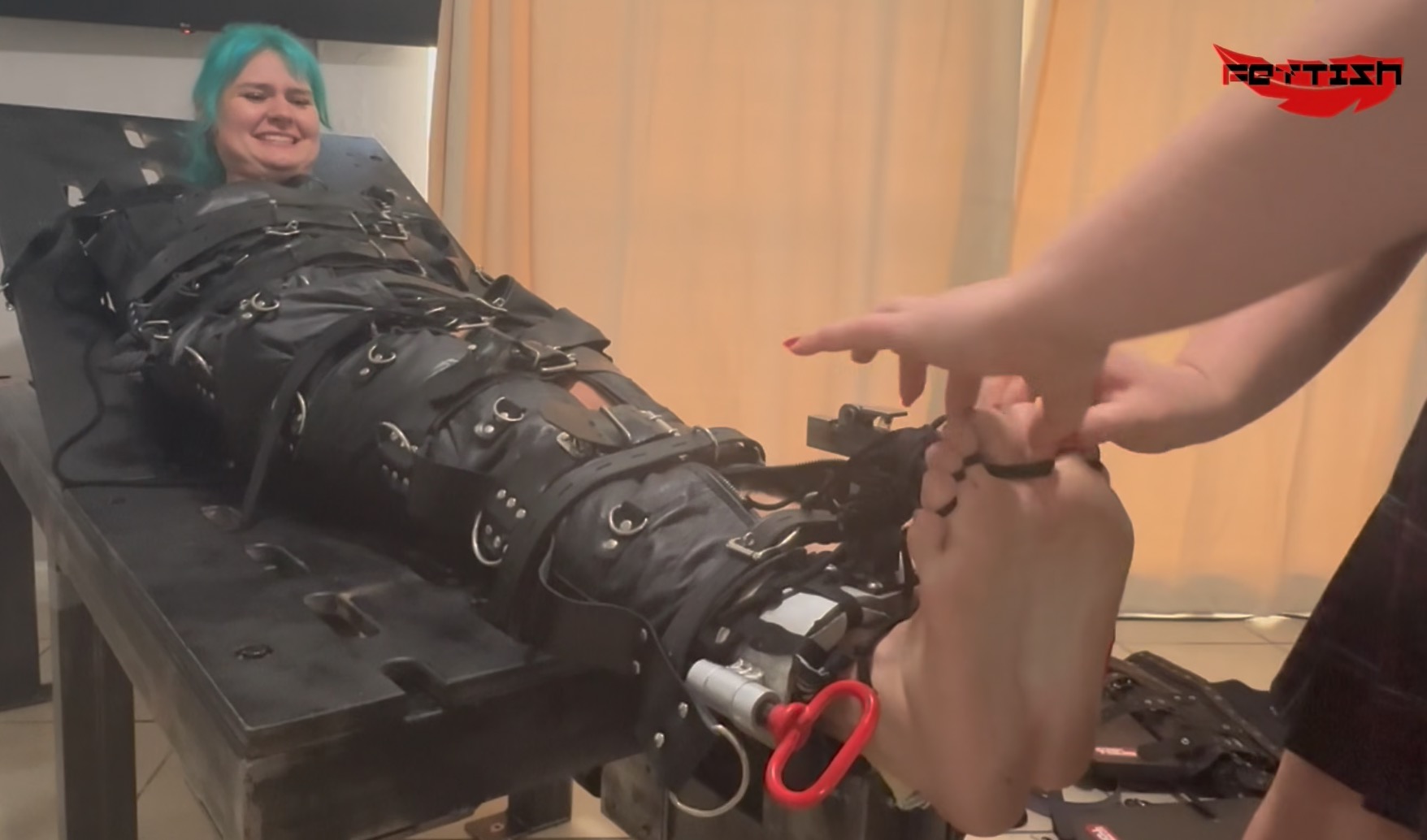
This study presents the baseline phase of a multi-stage investigation into the somatic sensitivity, reflexive resistance patterns, and affective vocalization responses of restrained subjects exposed to targeted tactile stimulation via the v2 Dynamic Tickle Table (v2-TT). The apparatus allows for precise biomechanical fixation and angular adjustment (0 –75 degree dorsal elevation), enabling optimal dermatomal exposure and immobilization. A female specimen, codename Charmie, was secured using the Immobilizer full-body mummification system, augmented with steel-reinforced stocks and a ratcheting T-Bar toe anchor. Exposed zones included the soles of bare feet, toes, inner thighs, lateral flanks (“sides”), lower abdomen (“tummy”), hips, and medial plantar arches (“runny zones”).
Stimulation protocols during baseline evaluation included manual (fingertips, knuckles) and instrumental modalities, applied across variable pressure and speed. Responses were measured via:
Vocal decibel output (80–125 dB peaks)
Limb micro-tremor via piezoelectric sensors
Facial contortion scoring (FCS-7 scale)
Pelvic lift reflex latency
Spontaneous laughter-to-squeal ratio
Results confirm feet (especially medial arch and toes) and sides (subcostal region) as highest-sensitivity zones, with inner thighs demonstrating delayed hypersensitization after anticipation. The v2-TT proves superior in sustained immobilization and zonal access over prior iterations.
Introduction
The somatosensory tickle response has long been studied as a mix of pleasure and helplessness. Recent advances in restraint ergonomics and stimulation control demand updated apparatuses capable of isolating dermatomes under maximal fixation. The v2 Dynamic Tickle Table represents a paradigm shift in experimental precision, integrating modular angle control, ratcheting distal anchoring, and multi-belt integration with full-body mummification.
This baseline experiment establishes sensitivity thresholds and reflex baselines across five high-yield zones prior to prolonged stimulation sessions.
Methods
Subject
Codename: Charmie
Status: Fully consenting specimen under long-term observation
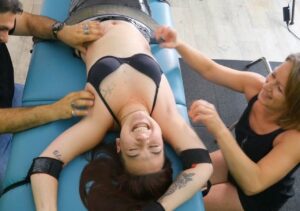
Restriction: Immobilizer leather mummification suit, head and feet exposed. Central ventral gap (3 cm width) exposing tummy, inner thighs, and hip creases.
Immobilization Sequence:
Subject placed supine on v2-TT
Legs extended into steel stocks (¼” iron pins securing ankle cuffs)
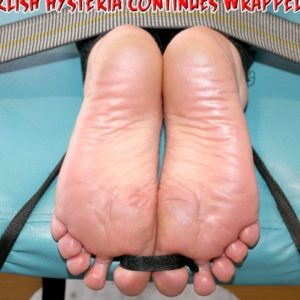
Toes individually threaded into T-Bar loops, ratcheted backward until plantar flexion reached 70°
8-point belt system secured torso and pelvis to table via reinforced leather slots
Table inclined to 35 degrees for optimal access
Final check: zero mobility in lower limbs, restricted pelvic tilt
Apparatus: v2 Dynamic Tickle Table
Frame: Aerospace-grade aluminum with magnetic damping
Angle Control: Hydraulic lift, 0 degrees (flat) to 75 (near-vertical)
Stocks: 4mm steel, laser-fitted to ankle profile
T-Bar: Ratcheting dual-axis bar with silicone-lined toe cuffs; adjustable spread (5–25 cm)
Surface Slots: 12 lateral and 6 central anchor points for belt integration
Access Zones: Feet, toes, sides, hips, inner thighs, tummy fully exposed
Stimulation Protocol (Baseline Phase)
Stimuli applied in randomized order across zones:
Bare Feet (Soles & Runny Zones) | Fingertips, feather, dual-tip probe | Moderate to high | Variable | Medial arch most reactive | | Toes | Fingertips, soft bristle, vibrator | Light to moderate | Slow | Each toe stimulated individually | | Sides (Lateral Flanks) | Fingertips, silicone brush | Moderate | Medium | Subcostal region most reactive | | Hips (Crest & Fold) | Knuckles, soft brush | Moderate to deep | Medium | Increased squirming observed | | Inner Thighs & Tummy | Feather, fingertips, vibrator | Light to moderate | Variable | Sensitivity increased with anticipation |
All stimuli applied by Lead Researcher and Co-Experimenter (Captured Kerry) who recorded vocal spikes and micro-movements.
Results
Sensitivity Ranking (Peak Response)
Feet (Medial Arch / “Runny”) – Immediate laughter, toe curling (despite fixation), DB max: 122 dB
Sides (Subcostal) – Rapid onset giggling, breath hitching, FCS-7: 6.8
Toes (Especially Pinky & Ring) – High-frequency squeals, pelvic lift attempts
Inner Thighs – Delayed but intense response; “ticklish buildup” effect observed
Tummy & Hips – Moderate response; deep pressure triggered rhythmic reflex
Immobilization Efficacy
Zero escape attempts successful
T-Bar ratchet prevented any toe flexion relief
All belts remained taut; no slippage observed
Subject reported “complete helplessness” post-session
Discussion
The v2-TT demonstrates unprecedented control over distal and proximal dermatomal exposure. The ratcheting T-Bar proves critical in maximizing foot and toe vulnerability, while the Immobilizer™ suit with strategic gap allows targeted access without compromising full-body restraint.
The “runny” zone (medial plantar arch) emerged as the most sensitive area, consistent with prior fMRI studies showing high-density nerve clustering in the hallucis and flexor digitorum brevis regions. The sides, particularly below the ribcage, showed rapid habituation resistance, making them ideal for prolonged stimulation protocols.
Future phases will implement predictive tickle algorithms based on this baseline data, using real-time vocal feedback to modulate stimulation patterns.
Conclusion
The v2 Dynamic Tickle Table, in conjunction with the Immobilizer™ system, provides a robust platform for high-precision tactile experimentation. Baseline data confirm feet, sides, and toes as optimal zones for maximal neuromuscular and affective response. This foundation will guide all subsequent stimulation regimens in the ongoing research series.
Acknowledgments
We thank Charmie for her unwavering compliance and vocal enthusiasm. Special thanks to Captured Kerry for her meticulous calibration work and real-time response logging.
Conflict of Interest
The authors declare no conflict of interest. All equipment used is property of the Institute. Specimen compensation includes post-session debriefing and light foot massage.